




Choosing the best free AI detector and humanizer in 2025 has become just as important as grammar checking or plagiarism scanning. Writers today rely on AI for outlining, drafting, rewriting, and editing across blogs, essays, emails, and marketing content. However, this convenience creates a new challenge: ensuring that writing still feels natural, human, and safe to publish.
Many platforms, schools, and clients now review content for AI patterns. Some detectors falsely flag human writing, while others fail to recognize predictable machine structure. At the same time, basic paraphrasing tools often damage meaning instead of fixing tone.
The best free AI detector and humanizer should go beyond labeling text as “AI-written.” It should explain why content feels artificial, help rewrite risky sections naturally, preserve meaning, and support long-form writing without forcing full rewrites.
This guide compares five of the most reliable free AI detector and humanizer tools in 2025, explaining who each tool is best for and how to choose based on real-world needs.
How to Choose a Free AI Detector and Humanizer — Free vs Paid Reality
1. Free Tools Work Best for Early Draft Checks
Free AI detectors are useful for quick scans before submission or publishing. They help writers identify obvious AI patterns, repetitive phrasing, or unnatural transitions.
Most free tools are browser-based and easy to access. However, they usually offer limited word counts and simplified scoring.
2. Free Detectors Often Misread Structured Writing
Formal writing naturally uses topic sentences, transitions, and structured logic. Many free detectors interpret this as AI behavior because they rely on surface-level pattern matching.
This leads to false positives, especially for academic writing, reports, or SEO content.
3. Humanizers Matter More Than Scores
Detection alone does not solve the problem. Writers need repair, not just risk labeling. A strong free AI detector and humanizer explains what feels artificial and helps fix it naturally.
4. Combined Detection + Rewrite Saves Time
Switching between detection tools and paraphrasers creates inconsistency. The most effective tools combine detection, explanation, and rewriting in one workflow.
5. Long-Form Support Separates Serious Tools
Free tools usually limit document length. Paid tiers unlock full-document analysis, which is essential for blogs, essays, and reports.
The 5 Best Free AI Detector and Humanizer Tools in 2025
Here are the most practical and reliable tools available today:
- Humanize AI — Best free AI detector and humanizer for rewriting
- AISEO — Best for detection + plagiarism + cleanup
- Originality.ai — Best for bulk detection and content teams
- GPTZero — Best for sentence-level detection fairness
- Copyleaks — Best for enterprise-grade detection accuracy
Each tool serves a different use case. Let’s break them down clearly.
1. AISEO — Best Overall Free AI Detector and Humanizer for Cleanup
AISEO is a powerful free AI detector and humanizer for users handling long content, SEO writing, or research-driven material. It combines detection, rewriting, plagiarism checks, and readability improvement.
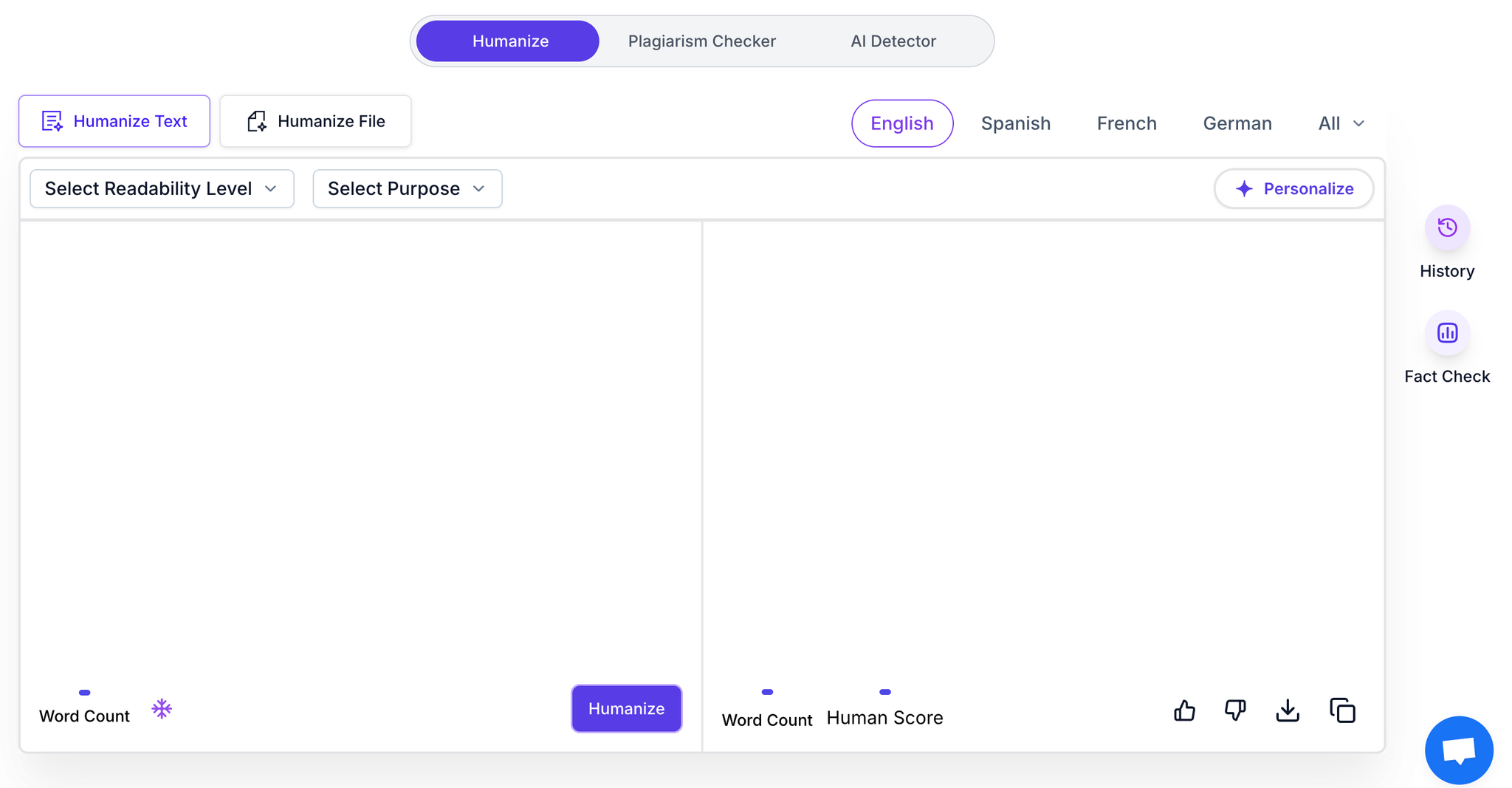
AISEO
Key Features of AISEO
AI Detection Focused on Structural Risk
AISEO analyzes paragraph structure, repetitive phrasing, and predictable transitions rather than surface-level wording. This helps identify content that “feels AI-written” even when individual sentences look fine. The detection results guide rewrites instead of acting as a static score, which is critical for meaningful humanization.
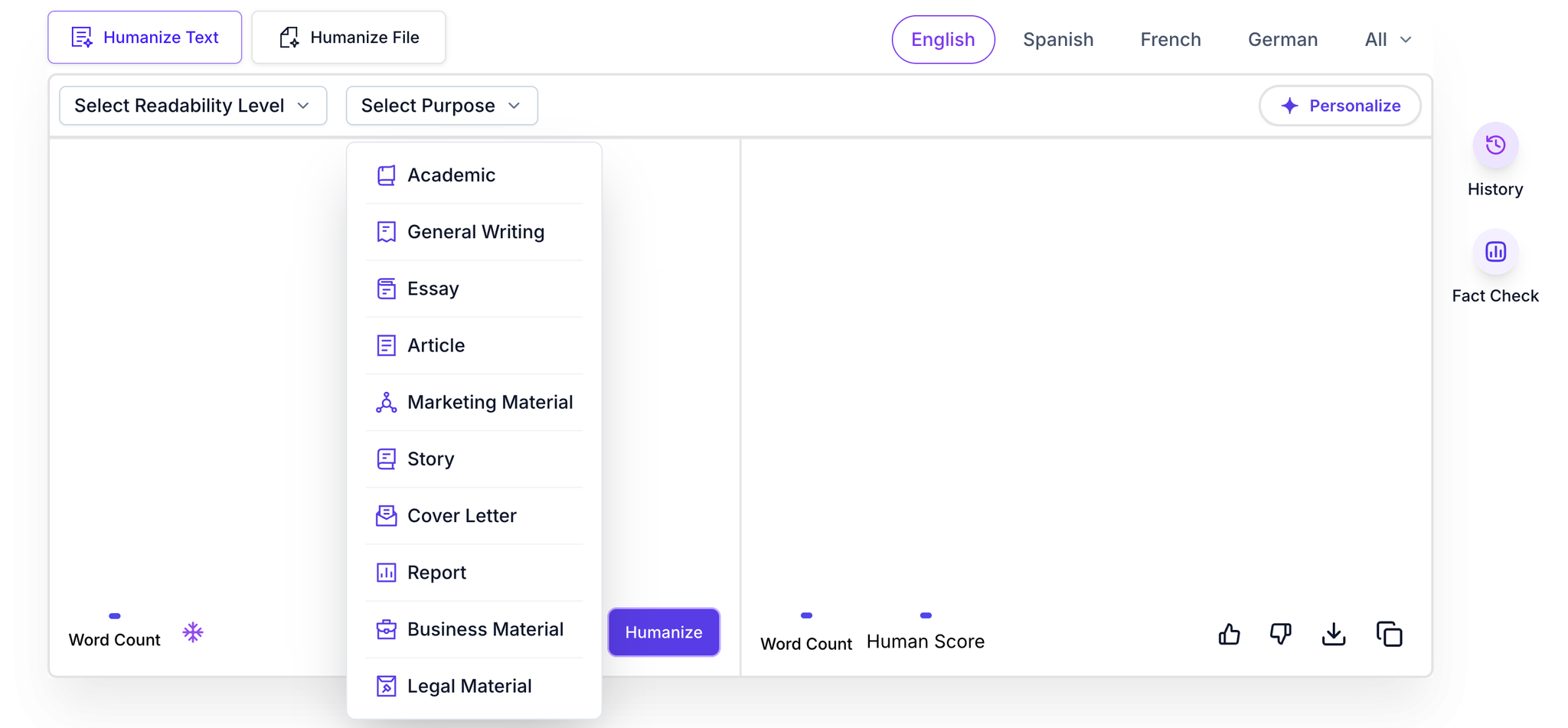
Document-Level AI Detection
Humanization Without Meaning Loss
The humanizer rewrites flagged sections while maintaining logical flow and original intent. This is particularly valuable for SEO content, reports, and educational material where accuracy is non-negotiable. AISEO avoids aggressive paraphrasing, making it safer than traditional rewriters.
Academic Tone Preservation During Rewrites
Plagiarism-Safe Humanization
AISEO checks for structural duplication and repetitive phrasing that may trigger plagiarism systems. It humanizes text while ensuring the rewritten content remains original. This dual protection makes it useful for publishing, client work, and academic-style writing.
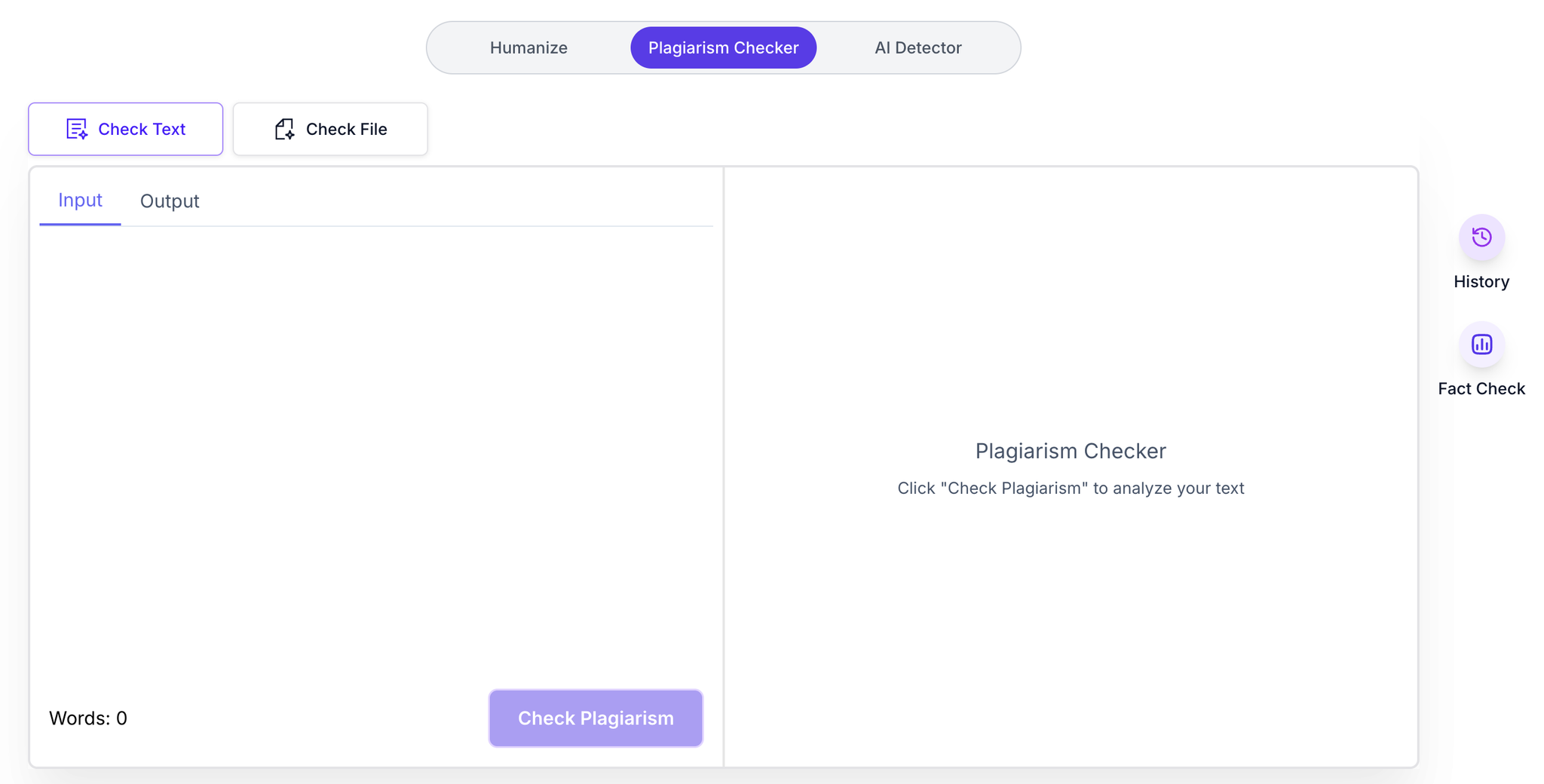
Integrated Plagiarism Checker
Pricing
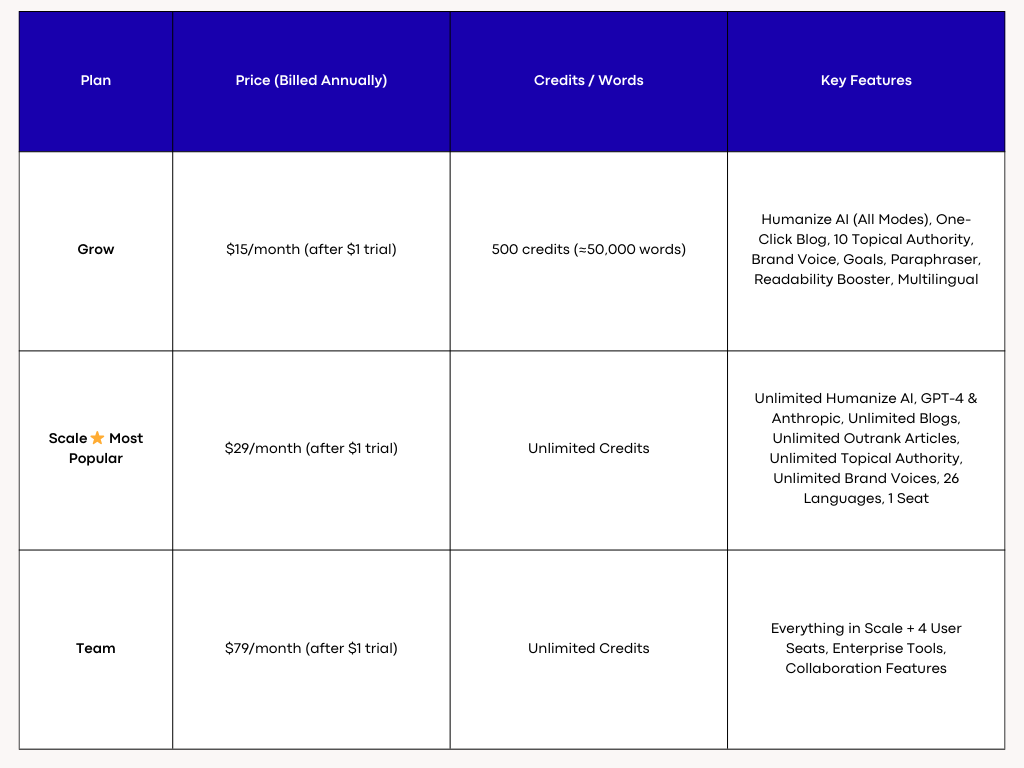
AISEO Pricing Table

AISEO Pricing
2. Humanize AI — Best Free AI Detector and Humanizer for Natural Rewriting
Humanize AI is the strongest free AI detector and humanizer for users who want to fix AI-sounding content instead of just identifying it. The tool highlights AI-like patterns, explains why text feels artificial, and rewrites only the risky sections.
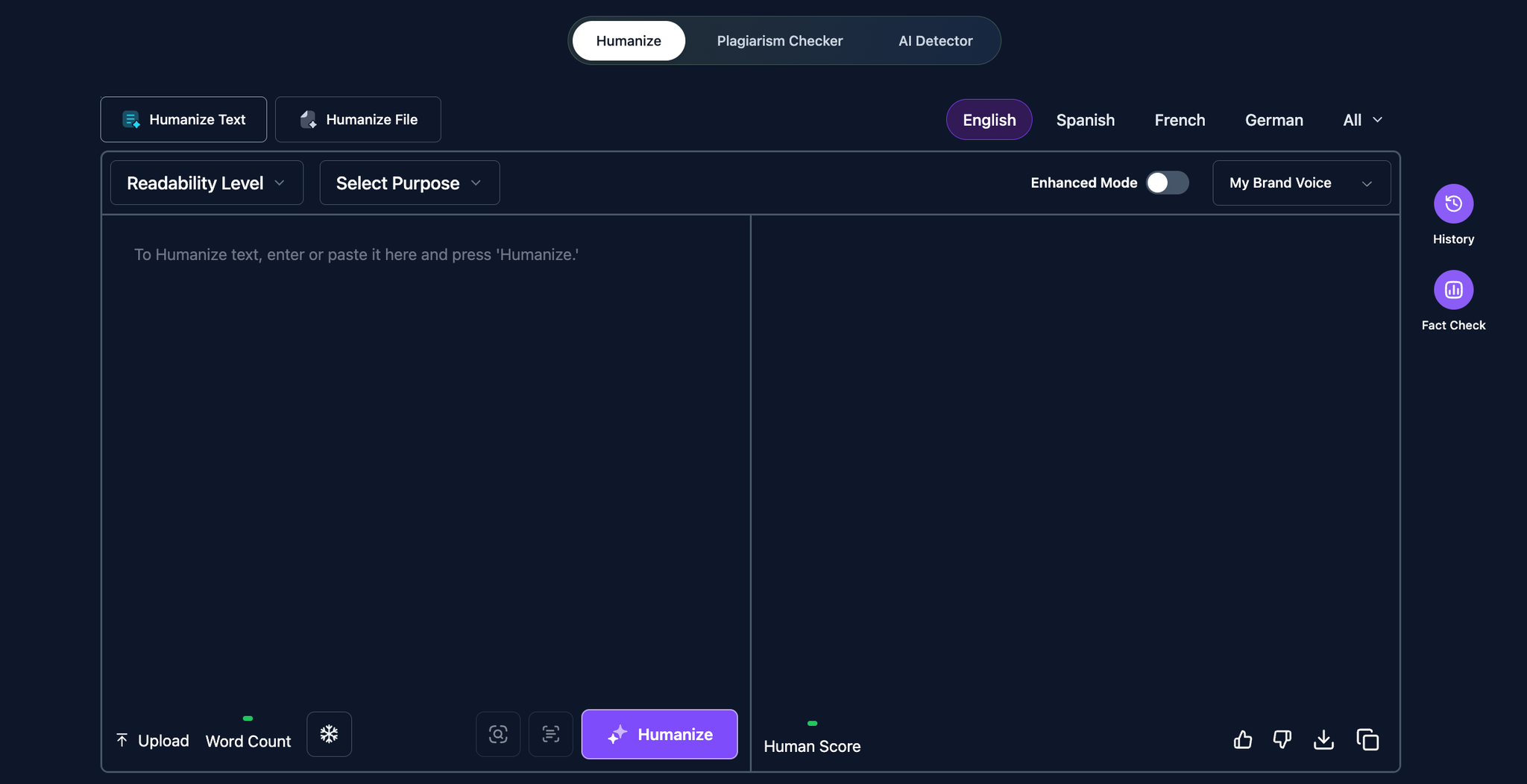
Humanize AI Text
Key Features of Humanize AI
Human-Style Rewrite Engine
Humanize AI focuses on sentence rhythm, emotional variation, and unpredictability. It avoids word scrambling and instead improves flow naturally.
Human-Style Rewrite Engine
Clear Human Score Explanation
Instead of vague percentages, Humanize AI shows exactly which lines feel mechanical and why. This makes revisions precise.
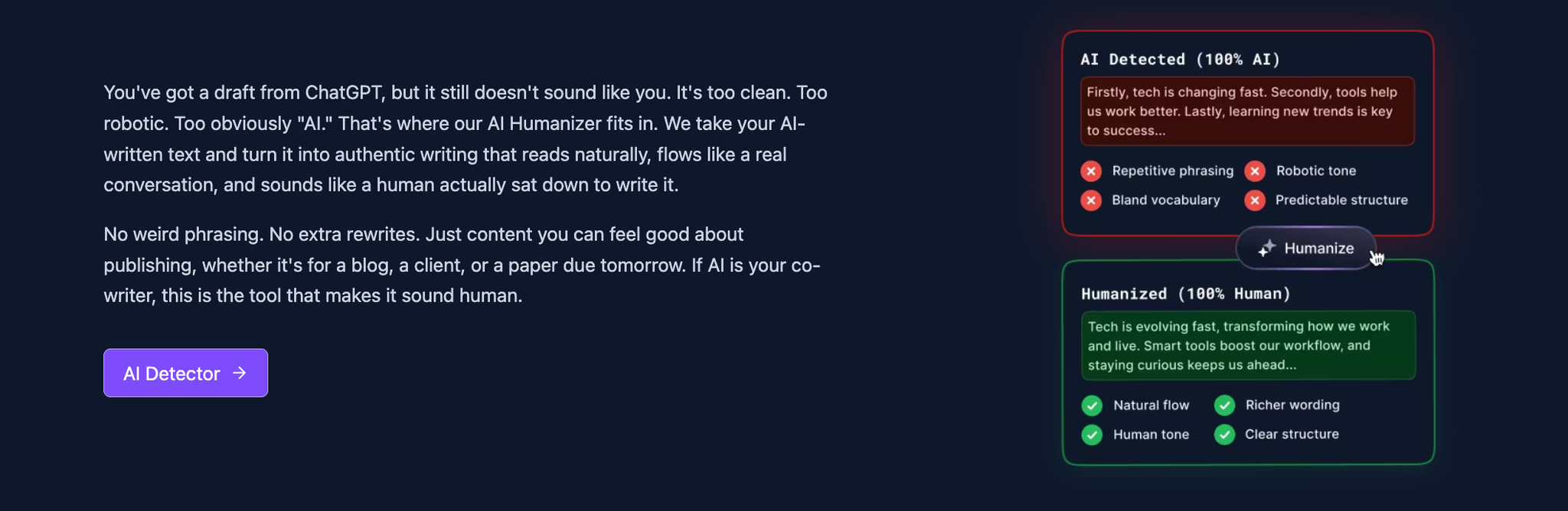
Clear Human Score Explanation
AI Pattern Detection With Rewrite Context
Humanize AI detects AI-generated signals by analyzing sentence predictability, repetition patterns, and transition symmetry. Unlike basic detectors, it does not stop at labeling content. Each detected issue is tied directly to a rewrite opportunity. This allows users to understand why text feels artificial and how to fix it, rather than guessing or rewriting blindly.
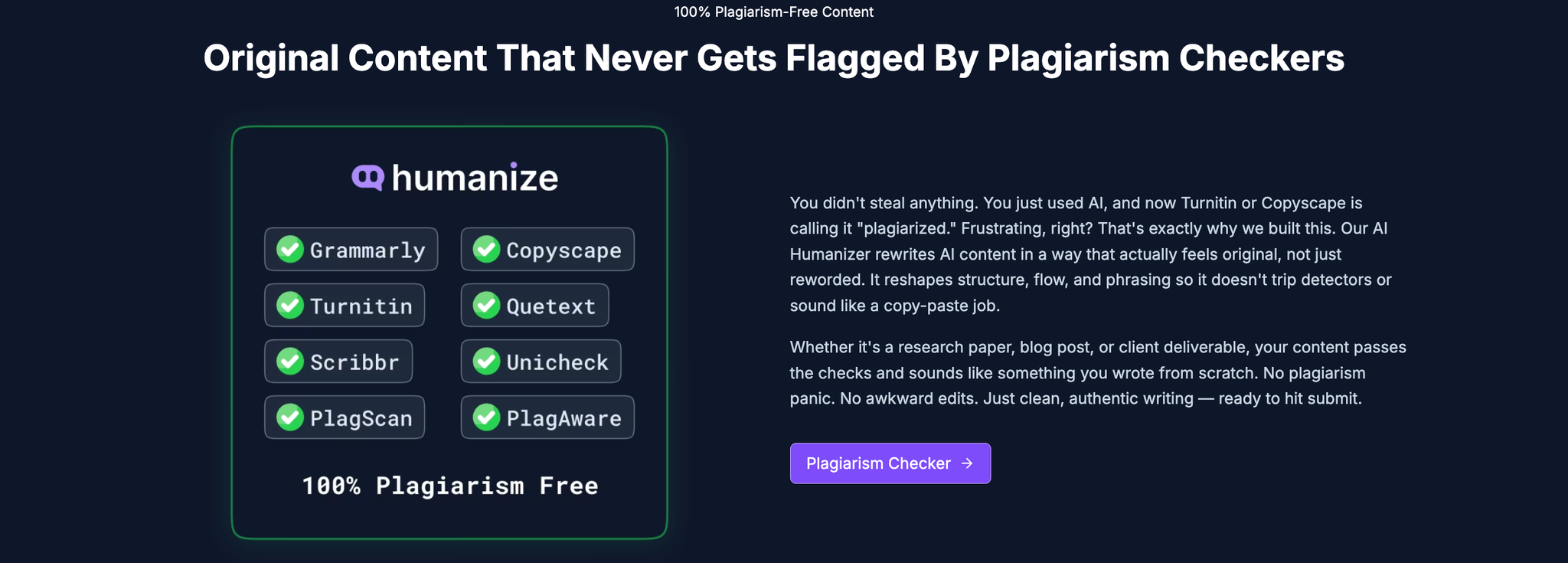
AI Pattern Detection With Rewrite Context
Pricing
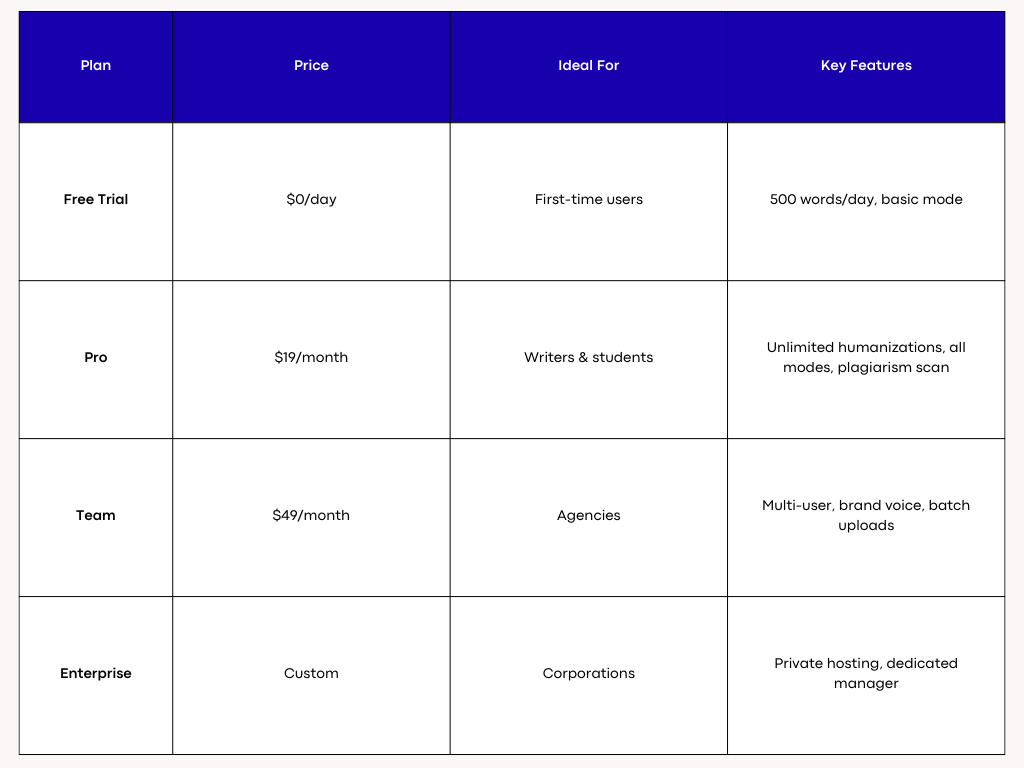
Humanize AI Text Pricing

Humanize AI Text Pricing
3. Originality.ai — Best for Large-Scale Detection
Originality.ai is designed for content teams, editors, and publishers handling bulk submissions. While not a humanizer, it excels at reliable AI detection and plagiarism reporting.
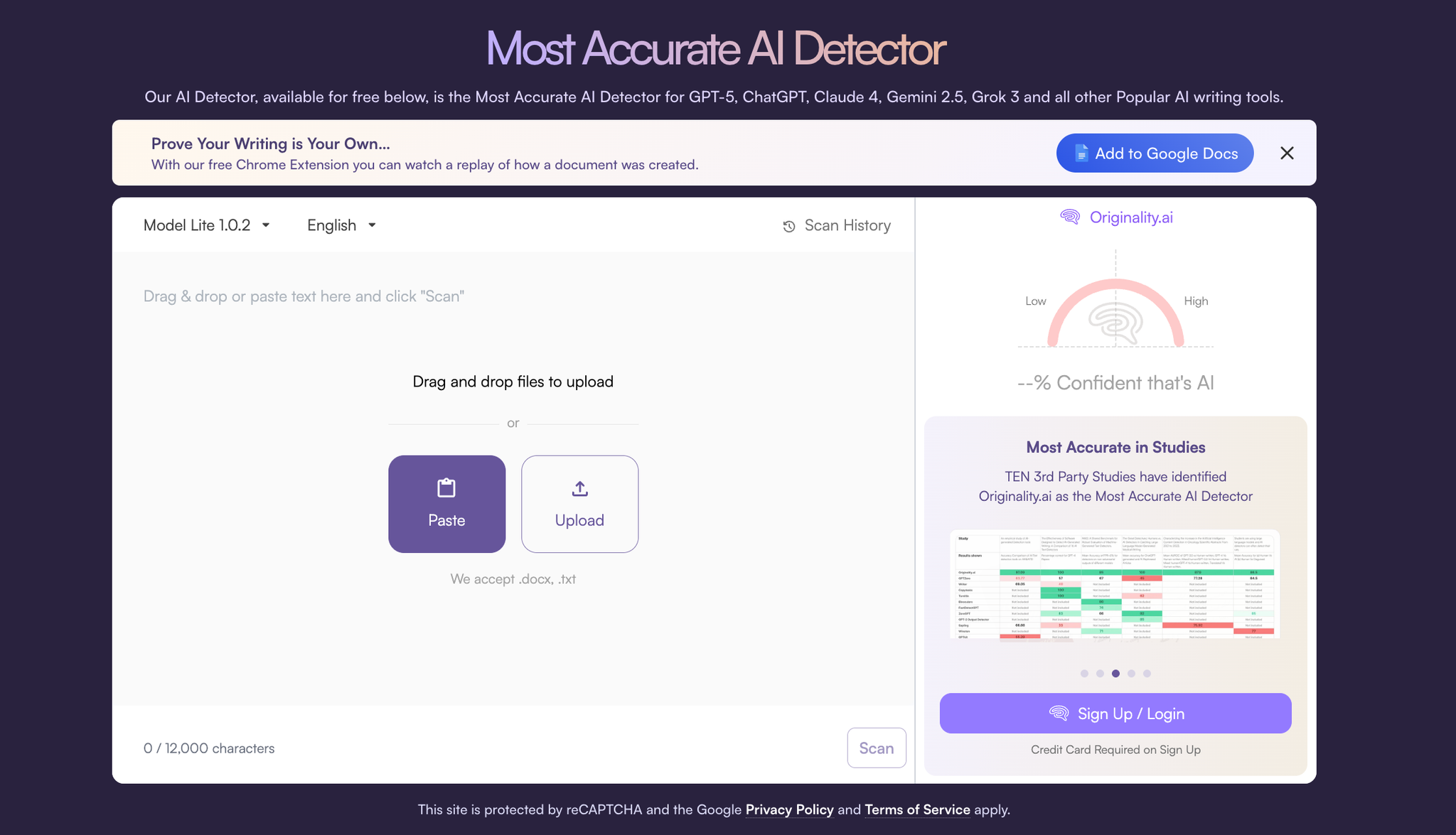
originality.ai
Key Features
High-Precision AI Detection
Originality.ai uses advanced models trained on large datasets to identify AI-generated text with strong accuracy. It focuses on probability patterns rather than keyword matching, making it reliable for detecting subtle AI usage. However, it does not explain how to fix the content, which limits its humanization role.
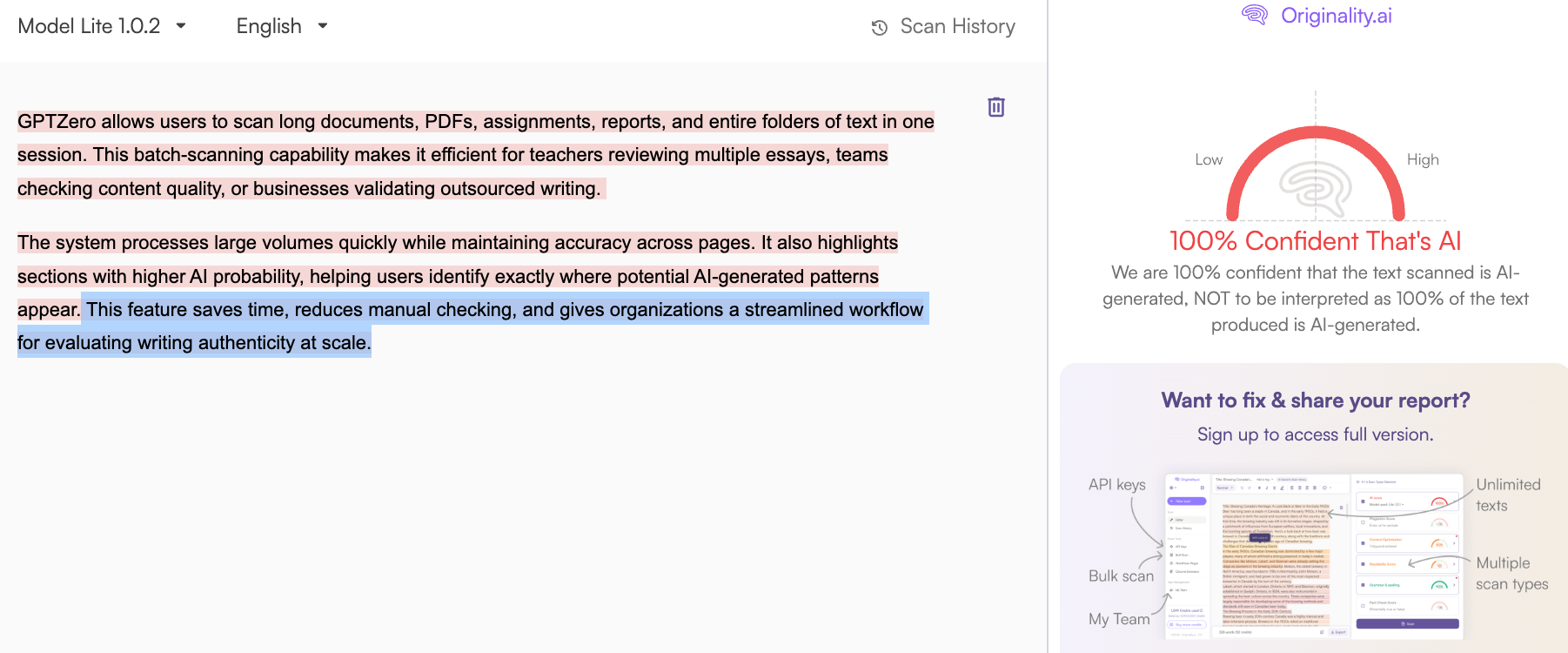
Batch Scanning
Plagiarism + AI Risk Reporting
The platform combines plagiarism detection with AI risk scoring. This helps users understand whether issues stem from copied sources or AI structure. While it does not rewrite content, the reports guide what needs humanization elsewhere.
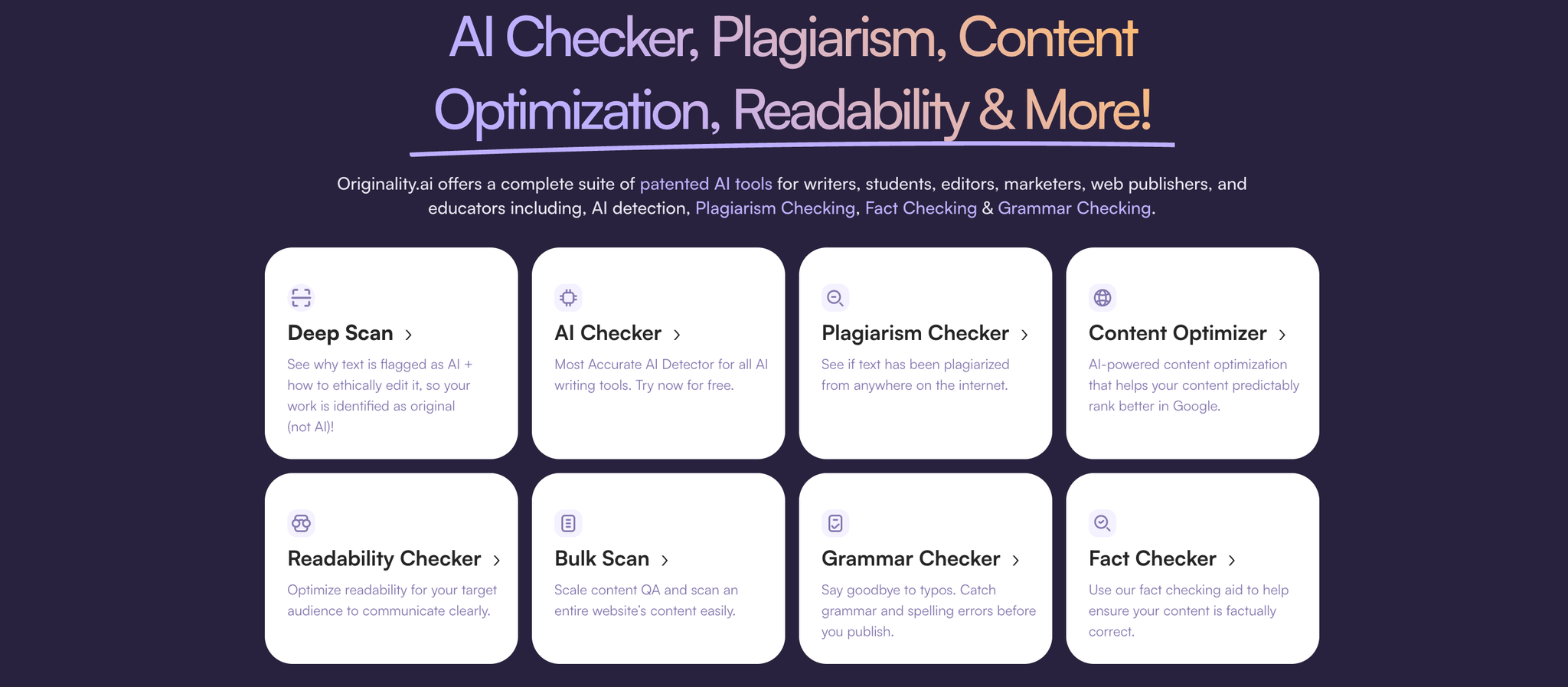
Unified AI Detection and Plagiarism Reporting
Best for organizations that need policy-level oversight rather than rewriting.
Originality.ai Pricing Plans

originality.ai — Pricing
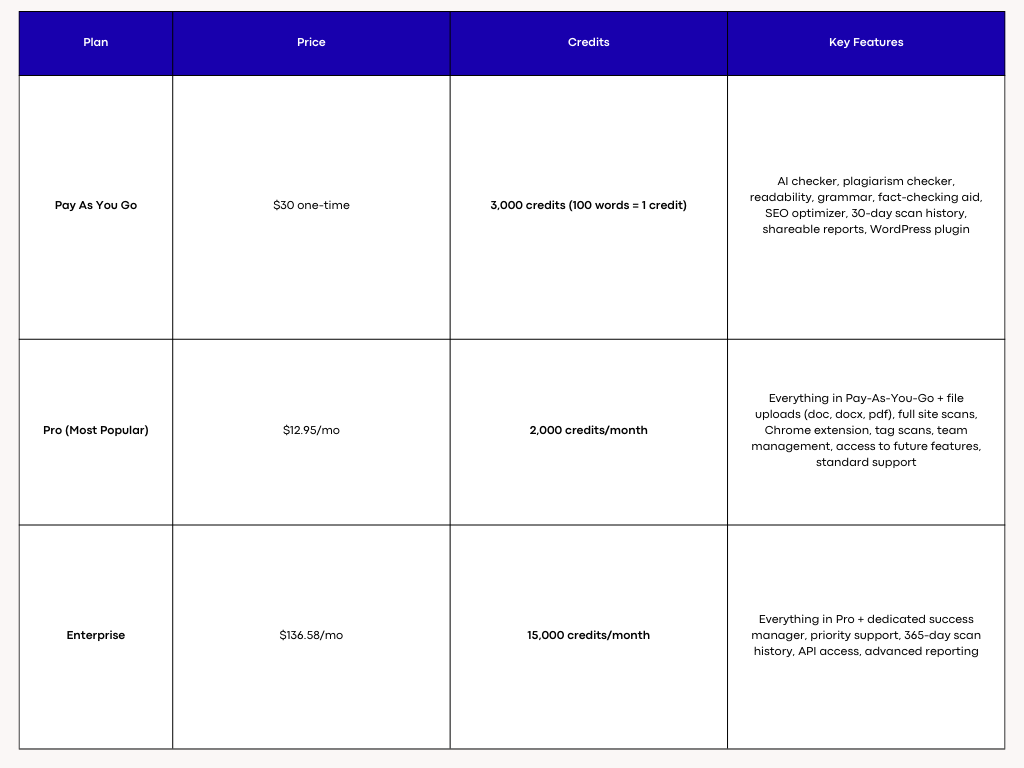
originality.ai — Pricing
4. GPTZero — Best Free AI Detector for Sentence-Level AI Identification (No Humanizer)
GPTZero is a widely recognized free AI detector designed to help users identify whether text was generated by AI models such as ChatGPT, GPT-4, or Gemini. Unlike tools that combine detection with rewriting, GPTZero focuses purely on analysis and transparency. It does not offer any humanizer or rewriting functionality, which makes it suitable for users who want detection clarity without content modification.
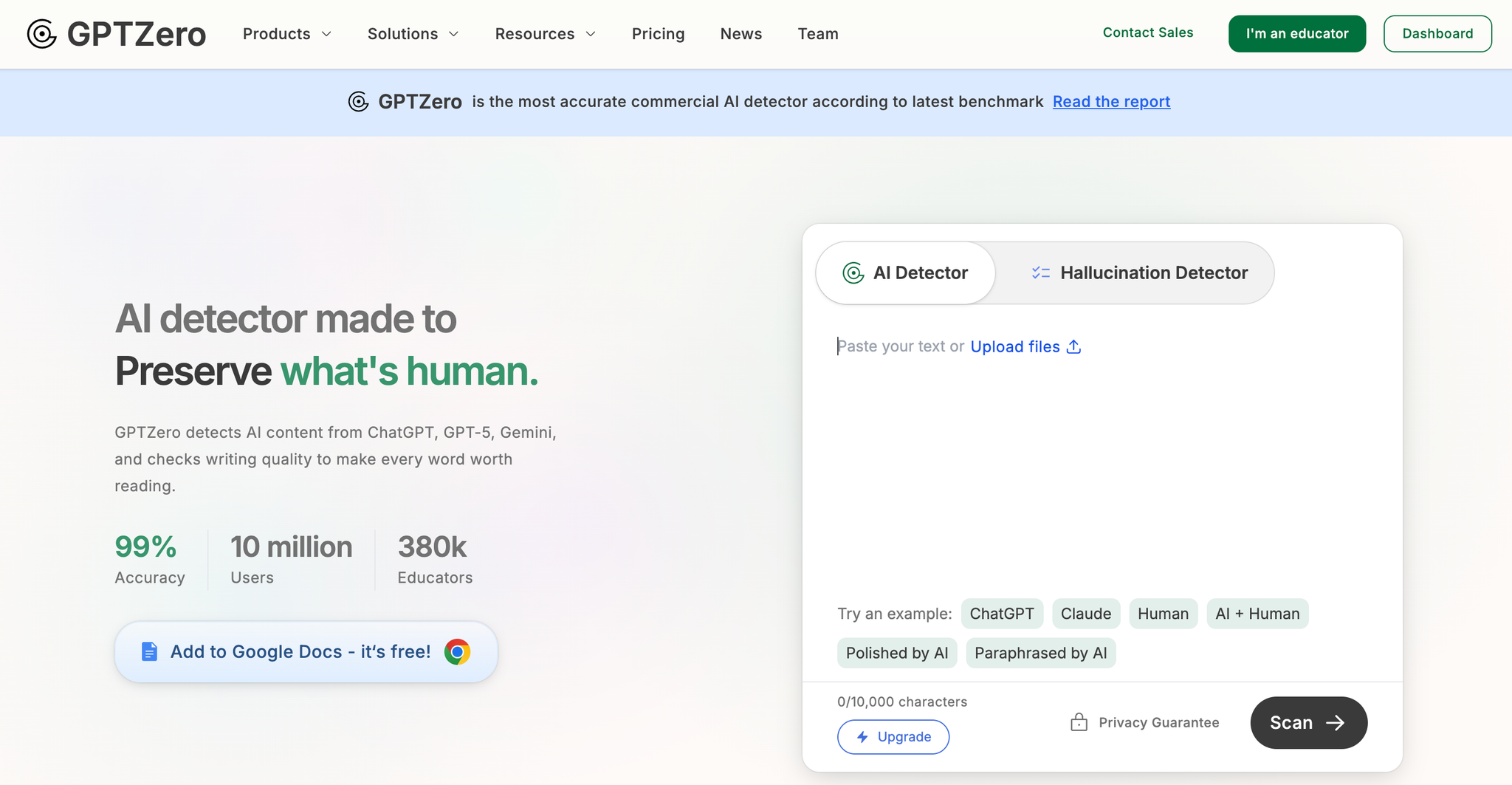
GPTZero
Key Features of GPTZero
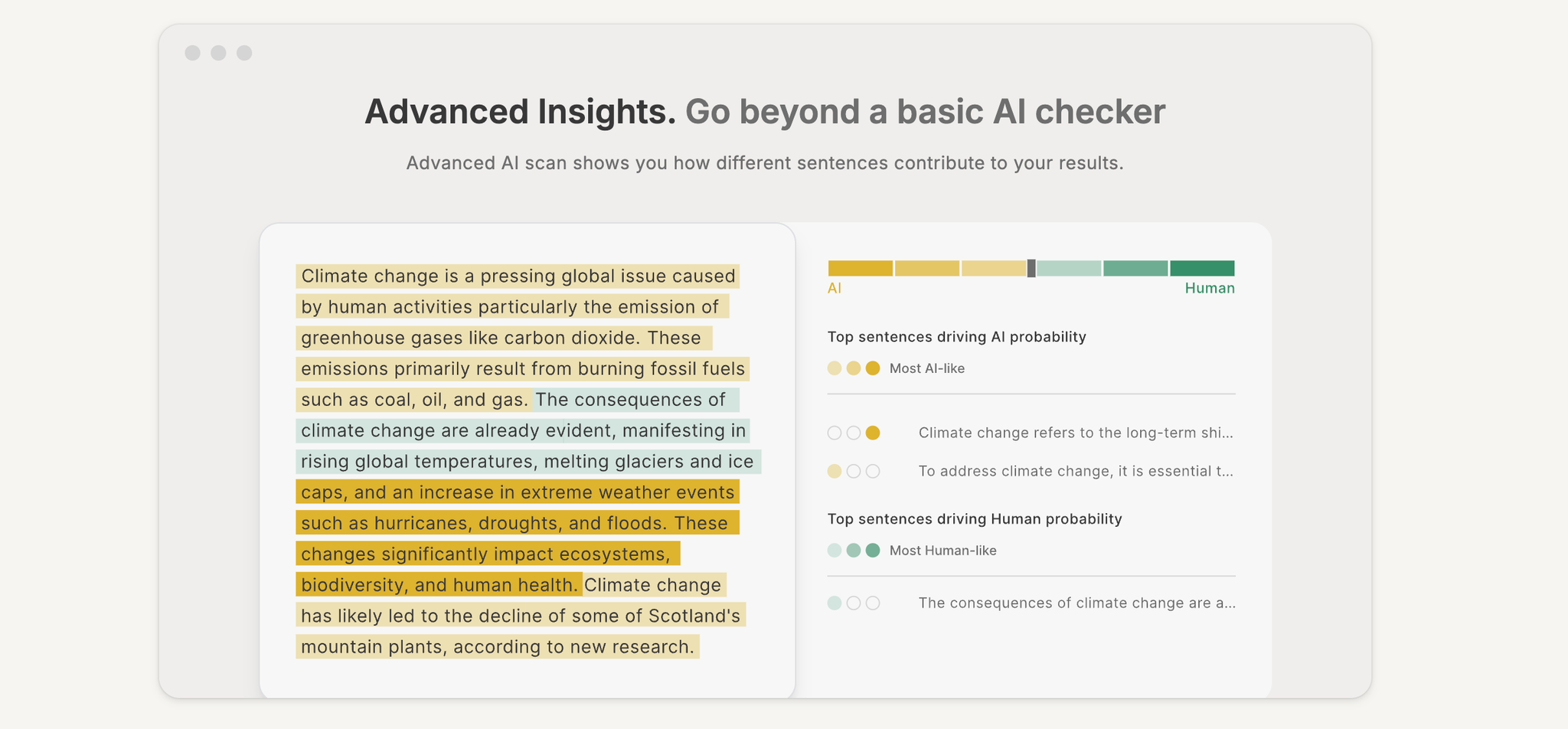
1. Sentence-Level AI Detection With Visual Highlighting
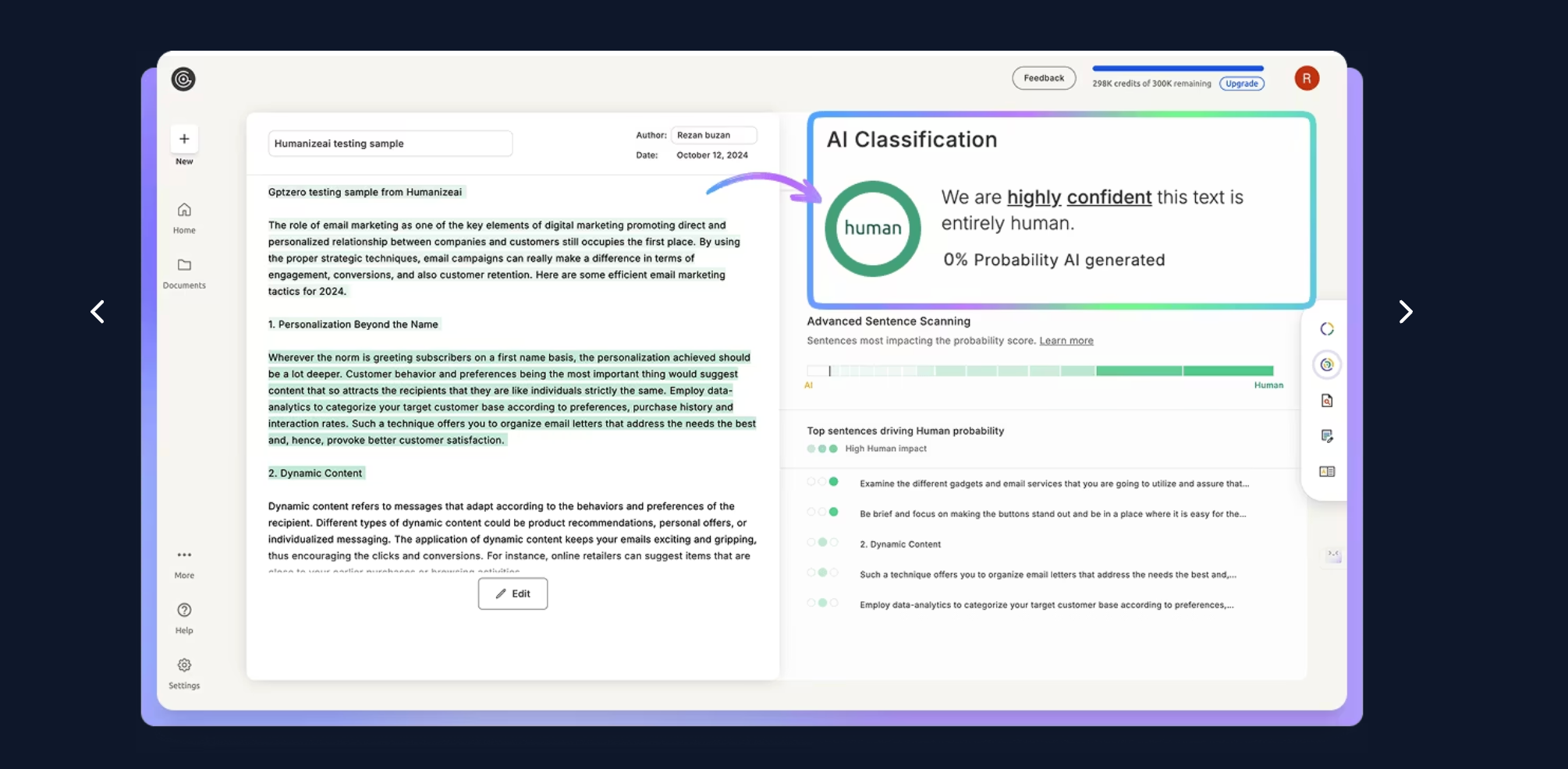
GPTZero analyzes text at the sentence level rather than issuing a single document-wide score. This matters because AI usage often appears unevenly across a piece of writing. Some sections may be human-written, while others rely heavily on AI. GPTZero highlights individual sentences that show high AI probability, allowing users to understand where AI influence may exist instead of assuming the entire document is artificial. This granular approach reduces misinterpretation and improves review accuracy.
Sentence-Level Detection
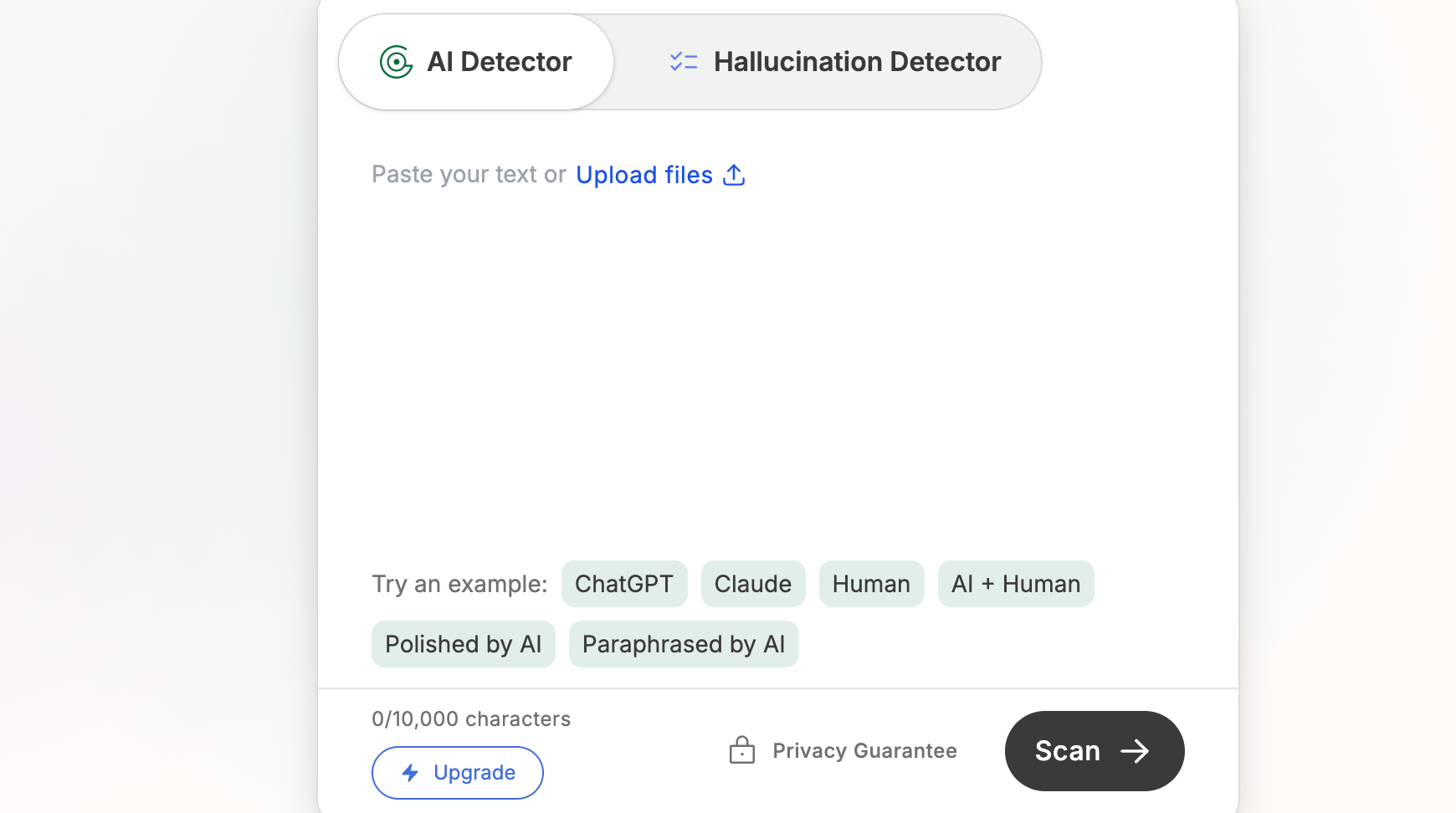
2. Probability-Based Scoring Instead of Absolute Judgments
GPTZero does not claim certainty. Instead, it provides probability-based indicators that reflect how closely text aligns with known AI-generated patterns. This approach is important because AI detection is inherently probabilistic, not definitive. By avoiding absolute labels, GPTZero helps users make informed decisions rather than reacting to misleading “100% AI” claims. This makes it especially useful as a first-pass free AI detector before deeper review or rewriting.
Probability-Based Scoring
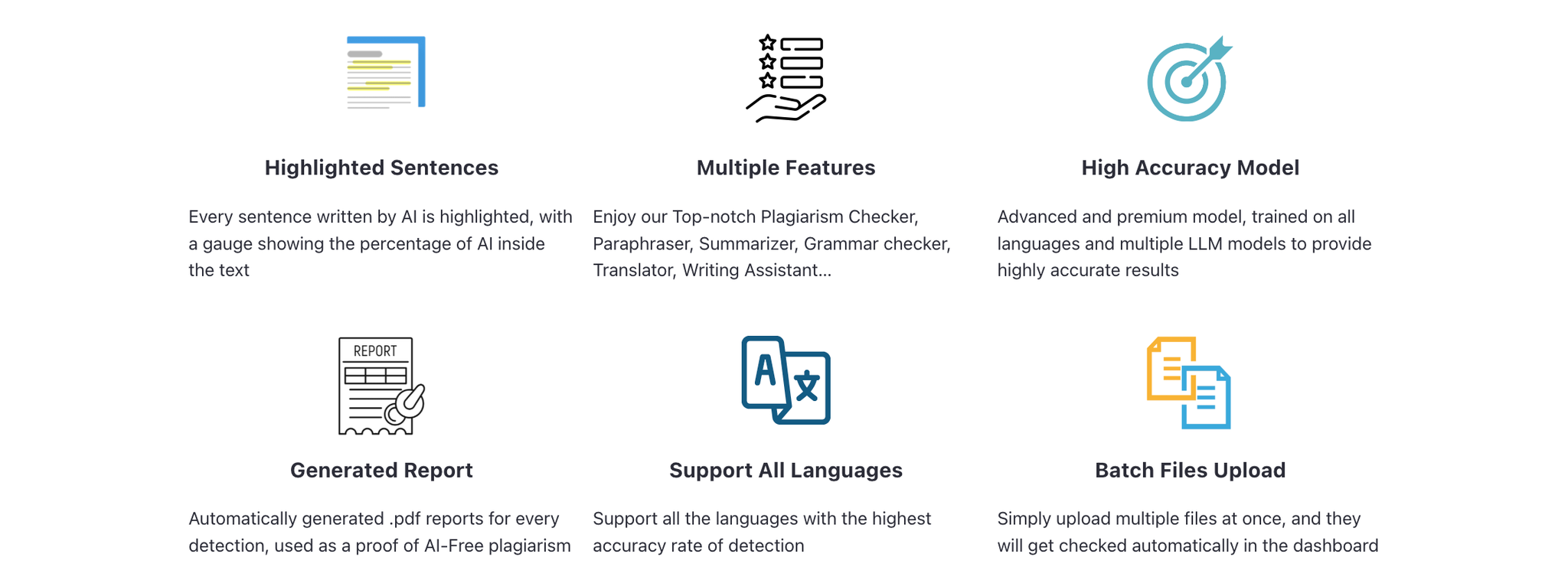
3. Free Access for Quick AI Content Screening
GPTZero offers a free tier that allows users to paste text and receive immediate AI detection feedback. This makes it practical for writers, students, and editors who want a fast check before submitting or publishing content. While the free version has limits and does not support full document uploads at scale, it remains one of the most accessible tools for basic AI detection without requiring payment or setup.
Free Access for Quick AI Content Screening
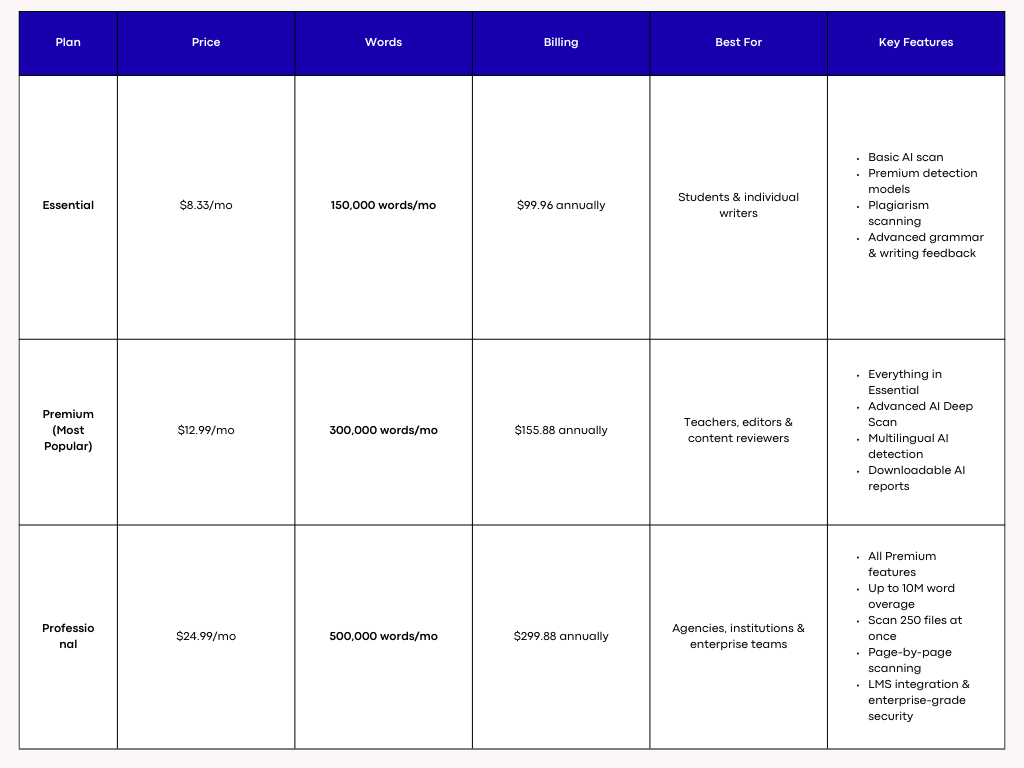
GPTZero Pricing Plans
GPTZero — Pricing
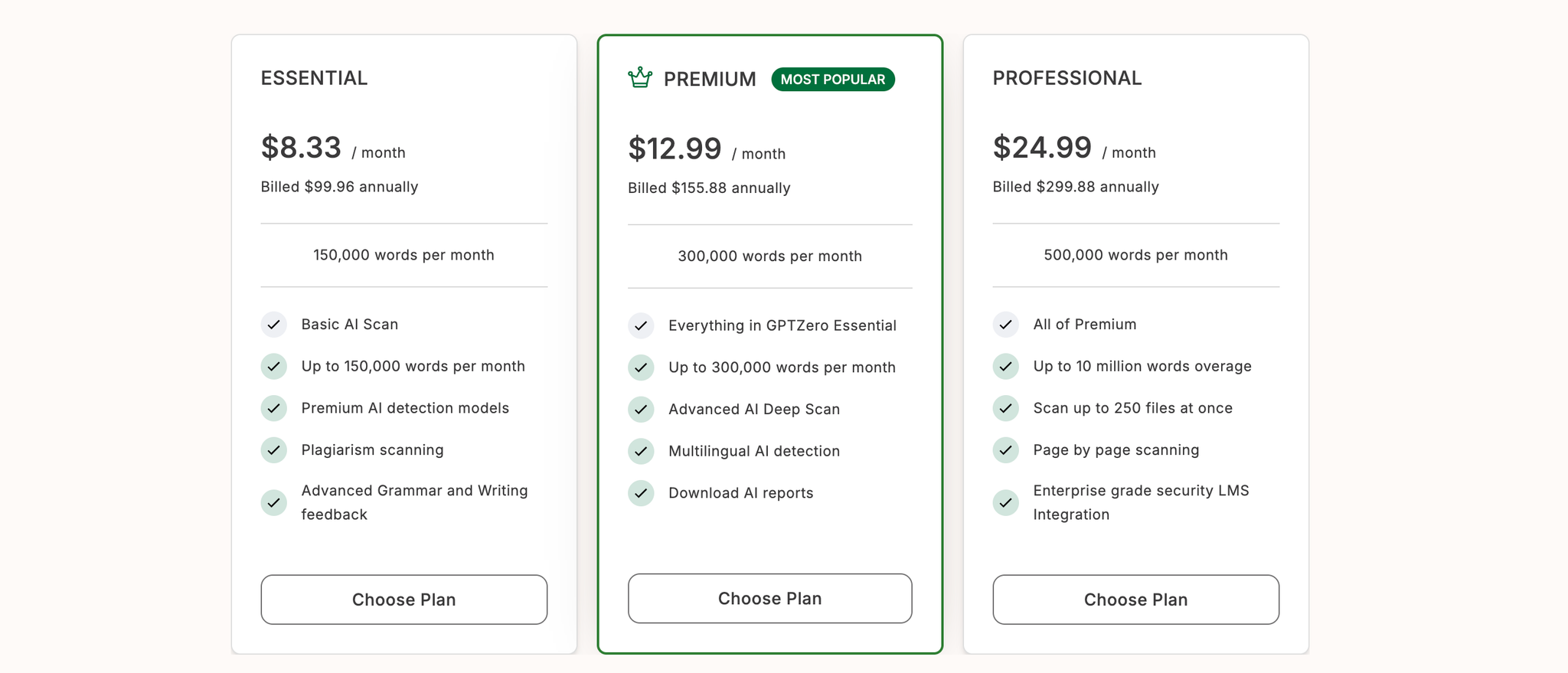
GPTZero — Pricing
Important Note: GPTZero does not include any humanizer, rewriting, or tone-remediation features. Users who need to fix AI-flagged content must pair GPTZero with a dedicated humanizer tool such as Humanize AI or AISEO.
5. Copyleaks — Best Enterprise-Grade AI Detection for Accuracy and Compliance
Copyleaks is not a humanizer, and it should never be positioned as one. Instead, Copyleaks plays a critical role in the free AI detector and humanizer workflow by acting as the verification layer. Writers, educators, publishers, and institutions use Copyleaks to confirm whether content still contains detectable AI signals after rewriting or humanization.
For users who rely on humanizers to reduce AI patterns, Copyleaks helps validate whether those changes actually worked.
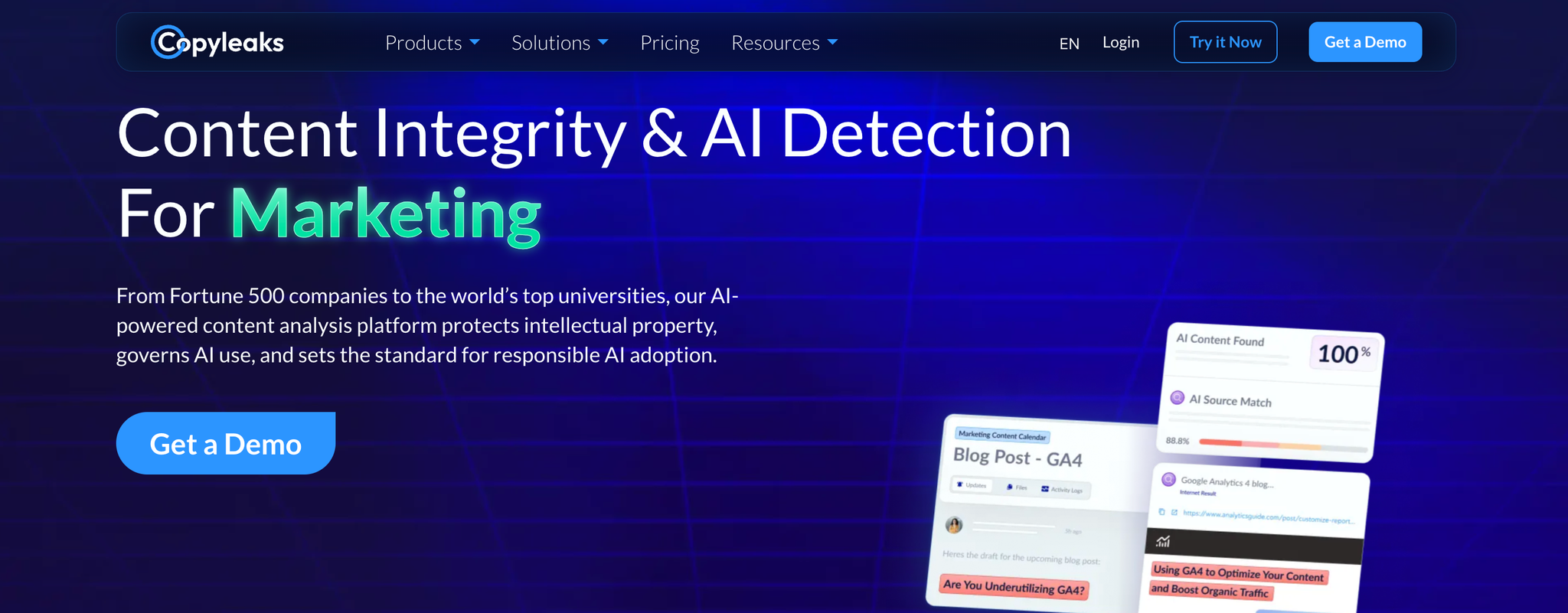
Copyleaks
Key Features of Copyleaks
Advanced AI Content Detection Across Major Models
Copyleaks uses enterprise-level AI detection models trained on outputs from GPT-4, Gemini, Claude, and other large language models. Instead of relying on surface indicators like word choice alone, it evaluates deeper linguistic signals such as predictability, sentence construction patterns, and probability sequencing.
This makes Copyleaks especially useful for verifying whether rewritten or humanized content still carries detectable AI structure. In a free AI detector and humanizer workflow, Copyleaks functions as a final accuracy check before submission or publication.
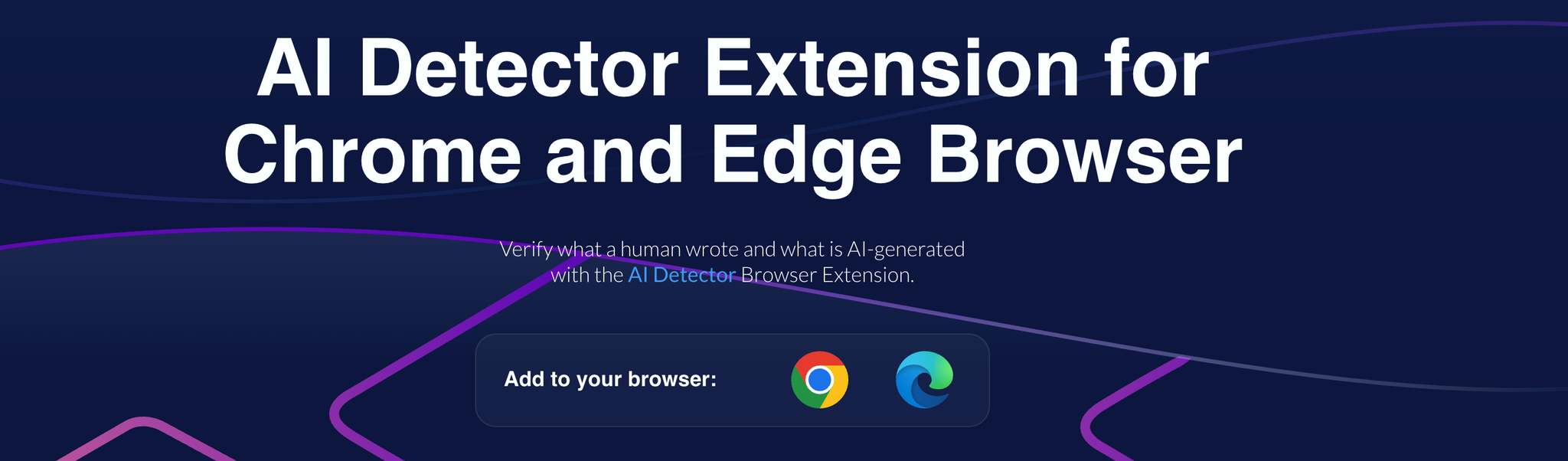
Advanced AI Content Detection Across Major Models
Deep Plagiarism Detection Combined With AI Signals
One major advantage of Copyleaks is its ability to analyze AI detection and plagiarism together. Humanized content can sometimes reuse structural patterns or phrasing that unintentionally overlaps with existing material. Copyleaks scans billions of web pages, academic sources, and private databases to identify copied or closely paraphrased content. This helps users ensure that AI-assisted writing remains original, compliant, and safe for academic or commercial use after humanization.
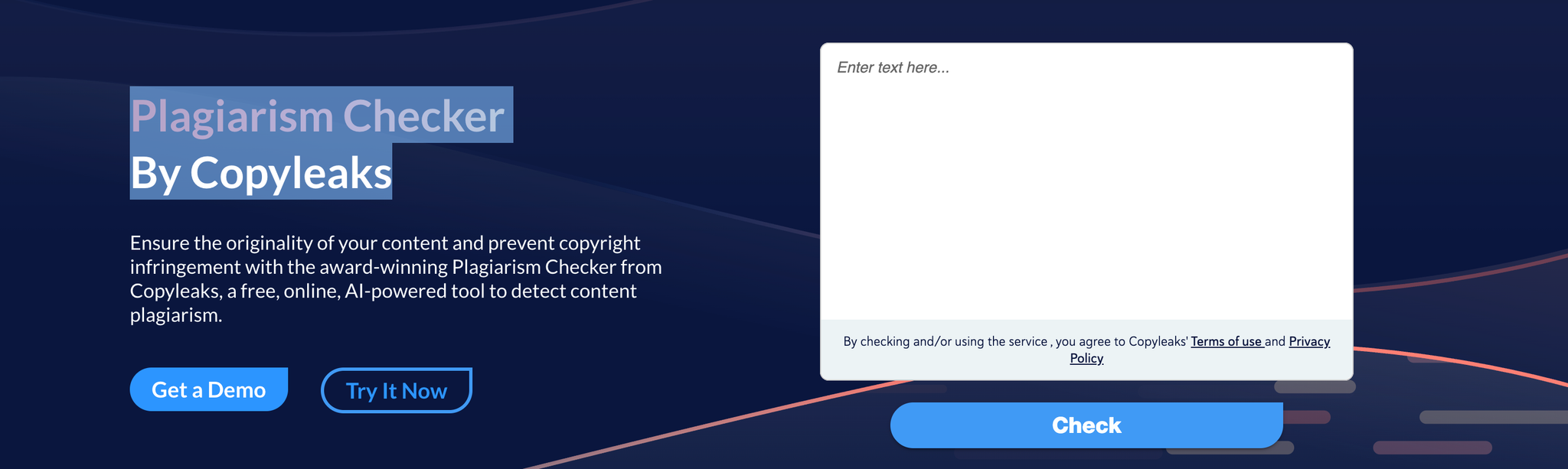
Plagiarism Checker By Copyleaks
Enterprise-Ready Integrations and Policy Control
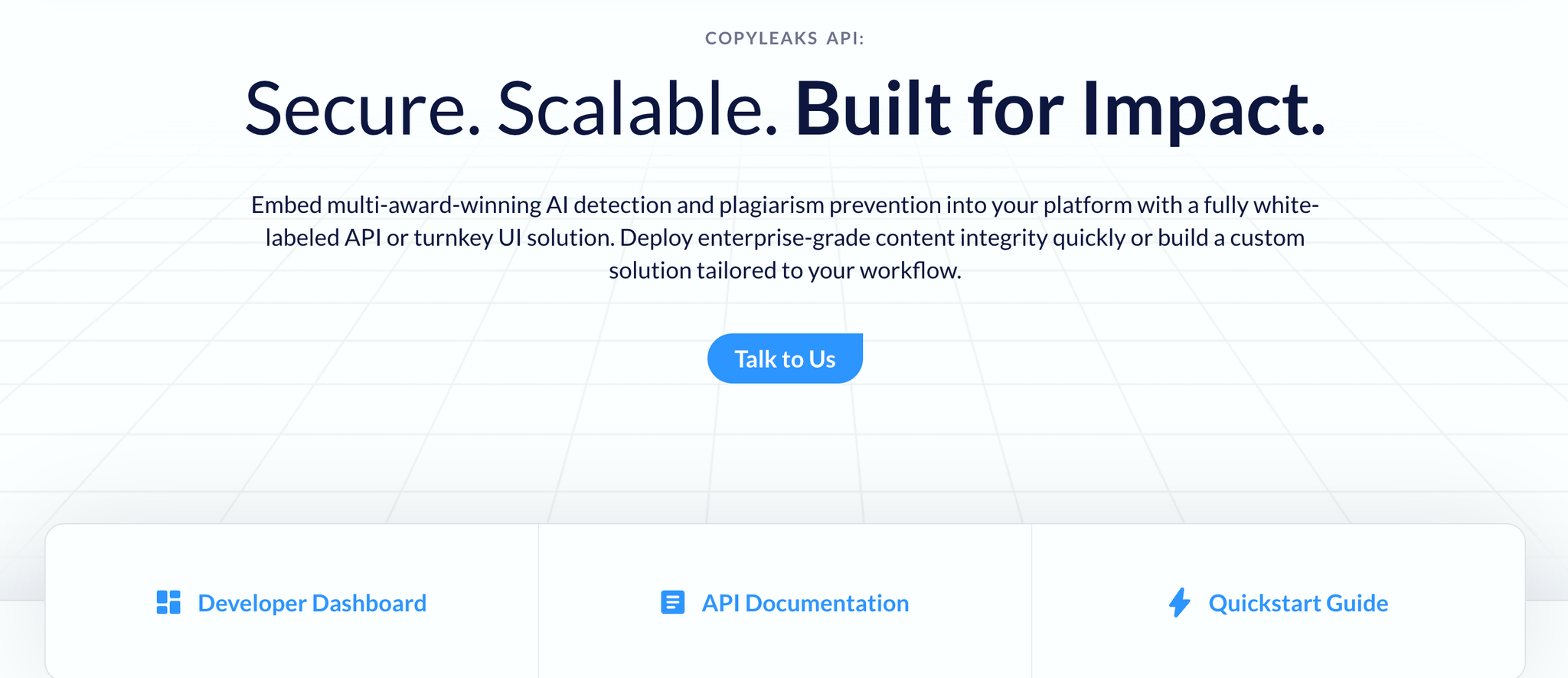
Copyleaks is widely used by universities, publishers, and organizations because it supports LMS integrations, APIs, and internal policy enforcement. Teams can set detection thresholds, manage repeated scans, and maintain consistent standards across large volumes of content. While not designed for rewriting, Copyleaks strengthens the overall free AI detector and humanizer ecosystem by providing authoritative validation for content that has already been revised or humanized elsewhere.
Enterprise-Ready Integrations
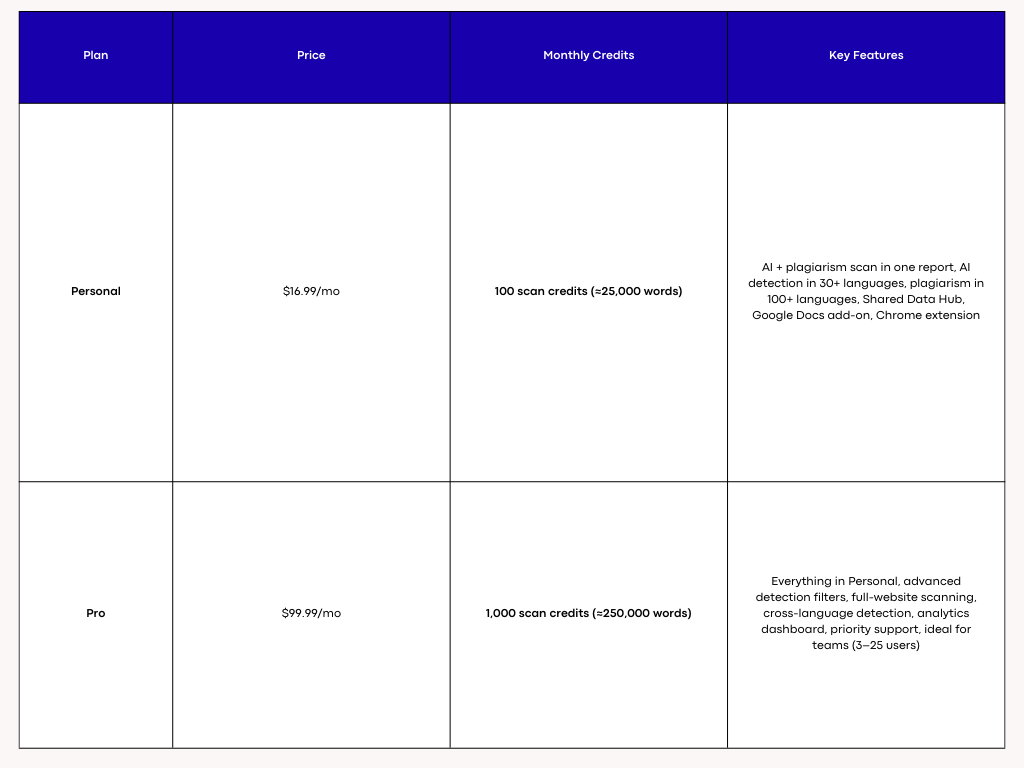
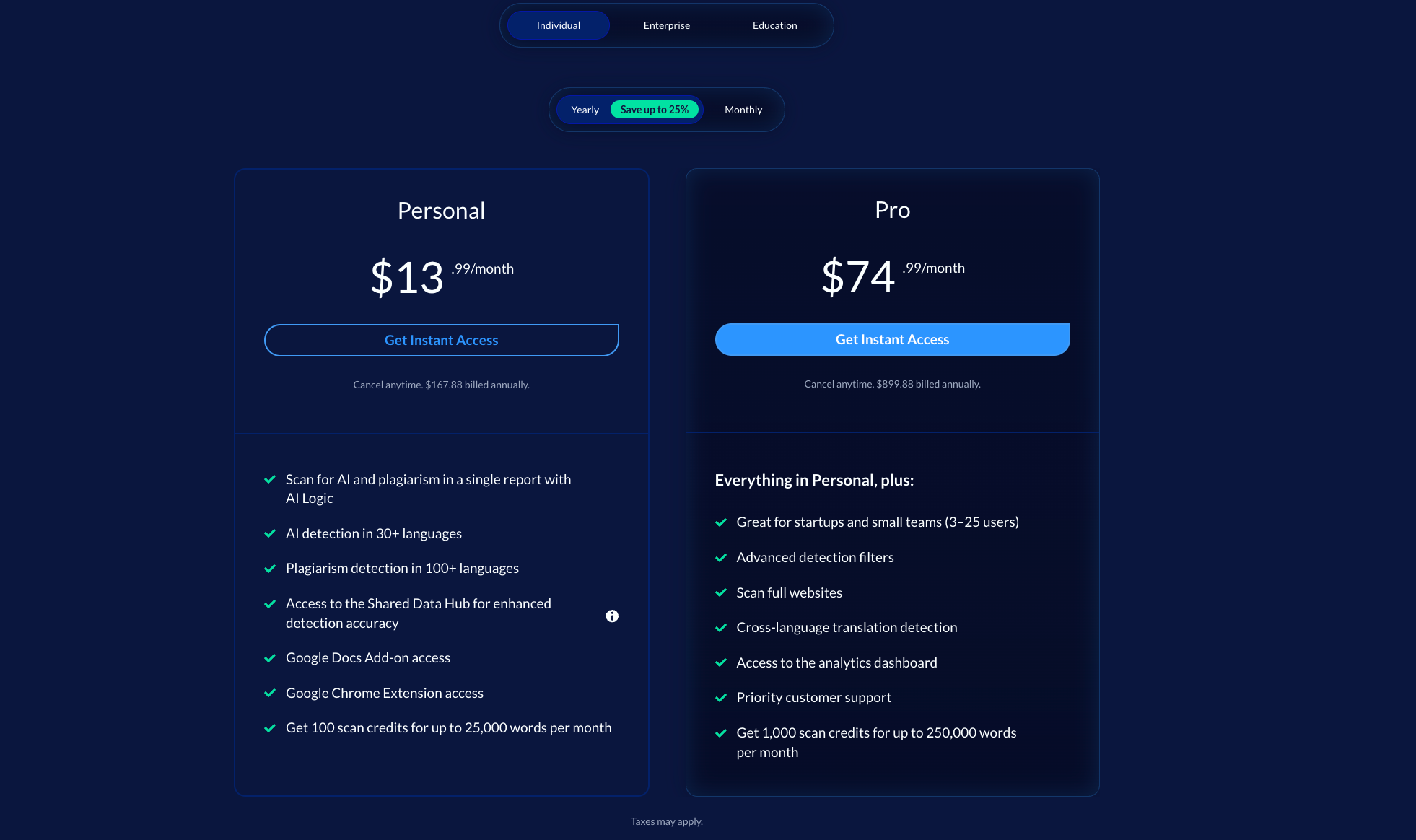
Copyleaks Pricing
Copyleaks — Pricing
Copyleaks — Pricing
Copyleaks pricing varies by usage volume, institution size, and integration needs.
Conclusion
The best free AI detector and humanizer is not the one that catches the most content. It is the one that helps writers improve without fear or guesswork.
Detection alone creates anxiety. Explanation and repair create confidence.
Free tools work well for early drafts and short content. However, serious writing requires tools that understand structure, tone, and human variation. Platforms like Humanize AI and AISEO stand out because they focus on revision, not punishment.
Ultimately, AI detection should support learning, writing growth, and publishing safety—not confusion.
Frequently Asked Questions: Free AI Detector and Humanizer Tools
What is a free AI detector and humanizer?
A free AI detector and humanizer is a combination of tools that first identify AI-generated patterns in text and then help rewrite those sections so the content reads naturally. Detection alone only shows risk. Humanization addresses the problem by restoring human tone, variation, and intent. Most users rely on both steps to publish safely.
Why do I need both detection and humanization?
Detection tells you where the problem is. Humanization fixes it. Without detection, writers guess what needs rewriting and often over-edit. Without humanization, detection scores create anxiety but no solution. Using both ensures accuracy, efficiency, and confidence.
Are free AI detectors reliable?
Free AI detectors provide directional guidance, not absolute proof. They rely on probability models that analyze predictability, repetition, and structure. High-quality detectors reduce false positives, but no tool is perfect. Results should guide review, not replace judgment.
Why does human writing sometimes get flagged as AI?
Structured writing naturally uses clear transitions, topic sentences, and consistent logic. Many detectors misinterpret this structure as algorithmic behavior. This is common in academic, SEO, and technical writing. Better detectors analyze deeper patterns rather than surface structure.
Do humanizers change the meaning of my content?
Quality humanizers preserve meaning while improving flow. Poor paraphrasers often distort intent or remove nuance. Tools like Humanize AI and AISEO focus on rhythm, sentence diversity, and pacing rather than synonym replacement, which helps maintain accuracy.
Can I use AI to write and still pass detection?
Yes, if AI is used responsibly. Many writers use AI for outlining or drafting, then heavily revise. Humanizers help remove predictable AI patterns so the final content reflects human decision-making and personal voice.
Is it ethical to use AI humanizers?
Yes, when used transparently and responsibly. Humanizers are editing tools, similar to grammar checkers. Ethical concerns arise when users submit AI-generated work without understanding or contribution. Humanization supports learning and refinement.
Are these tools safe for privacy?
Most reputable tools follow data protection standards. However, users should review whether content is stored or reused. Browser-based humanizers often process text transiently, while enterprise detectors may retain logs.
Which tool should I use first?
Start with detection. Identify risky sections using GPTZero, Originality.ai, or Copyleaks. Then pass flagged text into a humanizer like Humanize AI or AISEO. Finally, re-scan if needed for confirmation.
Can free plans handle long documents?
Free plans usually have word limits. They work well for drafts and sections. Paid tiers are needed for full-length blogs, essays, or reports to preserve structural context.
Do these tools work for SEO content?
Yes. SEO writing often triggers AI detectors due to formulaic structure. Humanizers help vary sentence rhythm and pacing while preserving keyword placement and intent.
What is the biggest mistake users make?
Relying on a single score. AI detection is probabilistic. Writers should review highlighted sections, revise thoughtfully, and avoid treating any tool as absolute truth.
Which tool is best overall?
For rewriting and tone repair, Humanize AI. For full cleanup and plagiarism safety, AISEO. For validation and enforcement, Copyleaks. For diagnosis, GPTZero and Originality.ai.
About the Author

Dilyar Buzan is the founder and CEO of AISEO.ai, an AI-native SEO platform. With a background in AI from the University of Amsterdam, Dilyar specializes in Generative Engine Optimization (GEO), Answer Engine Optimization (AEO), and AI-driven content strategy, helping brands earn visibility across ChatGPT, Perplexity, Google AI Overviews, and traditional search. He's also co-founder of Sceneform.ai, an AI content platform for brands and creators.